Karma is an optional run setting from the free update released alongside Hallowed Concepts. It does not require the expansion. When enabled, selected milestones raise Karma up to eight, and the accumulated levels make the Mithrix encounter on Commencement harder through cumulative statistics and attack changes. The effects apply to that encounter rather than globally increasing every monster's statistics throughout the run.
For a normal run, select the disabled Karma option in the lobby if you want the ordinary encounter. No Karma has a different meaning: it enables the system at a starting value of zero. Eclipse uses its own rule, starting at Karma equal to the Eclipse level, so the normal lobby toggle does not describe that mode's behavior.
Distinguish disabled Karma from a zero starting level
Open the Karma category in the lobby's run settings before beginning a normal run. The default Toggle Karma option disables the system. The option named No Karma starts an enabled run at zero, allowing milestones to raise it afterward.
That difference matters when you are trying to keep the Moon encounter unchanged. Beginning at zero does not lock the run at zero. If you enable the system and then complete a qualifying milestone, Karma rises and never decreases during that run.
The zero-start option requires Captain to have been unlocked through Washed Away. If nobody in the lobby has an unlocked option beyond the disabled default, the category displays that control over Karma is not allowed. An option unlocked by one player can be selected for the lobby, similar to the availability rules for Artifacts.
Before launching, check both the setting and the selected starting value. A run that starts at a higher unlocked level begins with those cumulative encounter changes already relevant; it does not wait for you to earn the same levels again through milestones.
Unlock higher starting levels by finishing a winning run
Winning with Karma enabled unlocks future starting levels up to the value reached at the end of that run. This applies to endings that count as wins, rather than requiring only one particular way of finishing the Moon route.
Other winning endings, including obliteration, can count. Eclipse runs also count. A run with Karma disabled does not unlock starting levels, so finishing an otherwise successful attempt does not supply Karma progress if the system was never active.
Use the end-of-run Karma result to verify the level you reached. The starting level and final level can differ because milestones increase the value during play. If you are planning a later run at a specific starting value, confirm that the prior win actually ended at or above that value.
Unlocking a starting level is separate from a Survivor skill challenge that asks you to defeat Mithrix at a particular Karma level. A winning alternate ending can unlock the starting setting without satisfying a challenge whose requirement is specifically a Mithrix kill.
Read Eclipse and alternate-mode rules separately
Eclipse starts with Karma equal to its Eclipse level: Eclipse 1 begins at one, and Eclipse 8 begins at eight. Milestones can still raise Karma during an Eclipse run until it reaches the cap. A low Eclipse level therefore does not guarantee the same low Karma value by the time you arrive at the Moon.
Simulacrum and Prismatic Trials keep Karma disabled. Do not use their behavior to infer which lobby choice is active in a normal run. They are separate mode rules rather than examples of a run that happened to earn no milestones.
At six Karma, Mithrix's reduced skill cooldowns do not stack with Eclipse 7's enemy cooldown reduction. The encounter still includes the other cumulative Karma changes, so that specific non-stacking interaction is not a reason to treat Karma as irrelevant in Eclipse.
Count milestones before committing to the Moon route
Most milestones award one Karma. Defeating False Son awards two. The value caps at eight and cannot be lowered afterward, so optional rewards and side routes can change the final encounter you are preparing for.
| Milestone | Karma gain | Repeatable in the run |
|---|---|---|
| Open the preplaced Legendary Chest in Abyssal Depths, Sundered Grove or Repurposed Crater | One | No |
| Defeat the hidden chamber's two Elder Lemurians in Abandoned Aqueduct | One | Yes |
| Defeat Alloy Worship Unit in Siren's Call | One | Yes |
| Defeat Aurelionite in Gilded Coast | One | No |
| Start the first Void Fields cell | One | No |
| Finish all nine Void Fields cells | One | No |
| Complete an Artifact trial | One | Yes |
| Get expelled from the Bazaar by Newt | One | Yes |
| Begin a new loop | One | Yes |
| One player holds an Elite Aspect | One | No |
| One player holds at least three Lunar items, including Lunar equipment | One | No |
| One player reaches fifty counted items | One | No |
| Defeat False Son | Two | No |
| Survive the Shrine of Descent Soul-binding trial | One | Once in practice |
The fifty-item milestone excludes Hexes, untiered objects, consumed forms, and temporary items. Count the qualifying inventory rather than every visible icon. The Lunar threshold is checked for a single player, so spreading three Lunar items across three different players is not the same condition as one player holding all three.
A Teleporter Boss killed at 10% charge or less can also award one Karma once per run. It does not count if Trophy Hunter's Tricorn was used on a member of that boss group. The exact trigger matters when you are deliberately planning a milestone rather than simply clearing the event quickly.
Include enabled expansions in the milestone plan
Expansion milestones only apply when their associated expansion is enabled. Seekers of the Storm adds the fully charged Halcyon Shrine reward and the False Son milestone. Alloyed Collective adds relevant Solus encounters, a Computational Exchange expulsion, and Meal-item conditions.
Hallowed Concepts adds milestones associated with surviving the Soul-binding trial, defeating the Anima Harvester, holding at least five Hallowed Items on a single player, and defeating the Echo of Providence. These are reasons a run exploring the expansion can arrive at the Moon with more Karma than the starting value suggests.
The Soul-binding trial is listed as repeatable by the milestone system, but the trial itself can happen only once per run. Treat it as one practical gain rather than plan repeated Shrine of Descent clears as a route to eight.
Decide whether optional content serves the current goal. If you are learning the added encounters, that may justify the later difficulty. If you are trying to practice a particular low-Karma Mithrix encounter, check which side route or inventory threshold would raise the level before taking it.
Understand the cumulative encounter thresholds
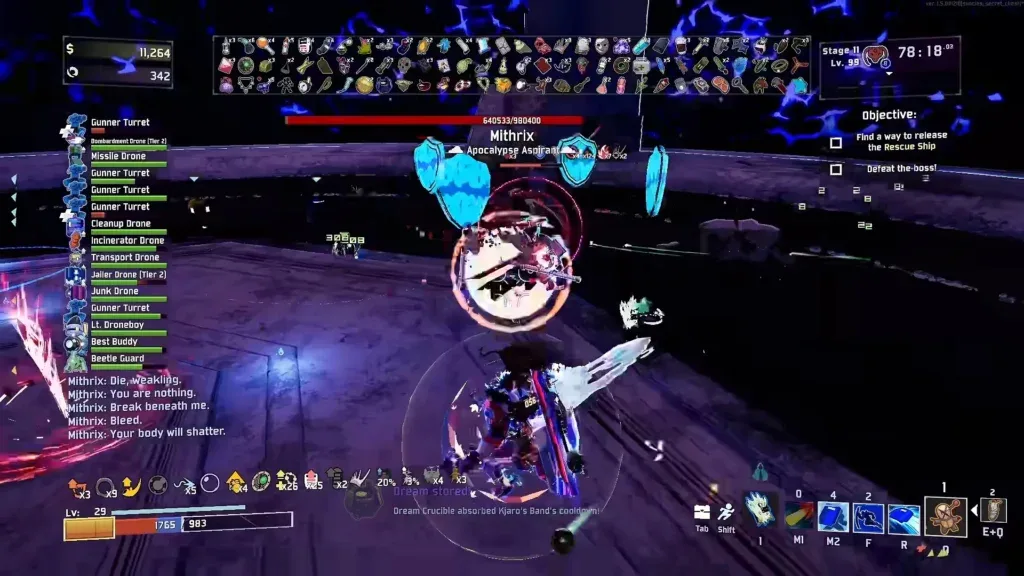
Each Karma level includes the changes from all lower levels. Five Karma is not an isolated fifth variant that replaces levels one through four; it combines those effects. Mithrix also gains 1% damage per Karma, with larger statistical changes at specific thresholds.

| Karma threshold | Important added behavior |
|---|---|
| One | A periodic protective shell limits hits to one damage after a damage threshold. |
| Two | Faster movement and attacks, added Shock Wave pressure, dash spikes, and phase-two item distribution. |
| Three | Extra hammer waves and crystal spikes, faster needles, and death hazards in phase two. |
| Four | Meteor pressure, additional phase-four spike patterns, and the Apocalypse Aspirant subtitle. |
| Five | Karmic Spires at selected phase starts and a phase-two throne attack. |
| Six | Reduced skill cooldowns and further attacks, including additional late phase-four behavior. |
| Seven | No new attack package beyond the continuing damage increase. |
| Eight | 50% extra maximum health, plus presentation changes. |
At two Karma, movement and attack speed rise by 30%. At six, skill cooldowns are reduced by half, with a separate floor on the relevant special attack in phases one and three. At eight, the larger health pool extends the encounter in addition to the attack changes already accumulated.
Respond to the protective shell and added hazards
At one Karma or more, Mithrix gains a five-second shell after taking damage equal to 10% of maximum health in the relevant phases. During that shell, each hit is reduced to one damage. The damage tally resets after the trigger, and hits taken while protected do not build the next tally.
Recognize that protected period rather than interpret a series of tiny hits as a broken weapon or a missing damage item. Use the opportunity to preserve movement and prepare for the next meaningful damage window. The shell changes when your attacks are effective, not simply how much damage the inventory claims to supply.
Higher levels add threats around attacks that are otherwise familiar. A leap can produce additional shock waves and a pulling effect, hammer impacts add waves or spikes, and deaths in phase two can leave hazards at the monster's position. Keep looking at the area an attack affects rather than only at Mithrix's body.
Karmic Spires appear from five Karma onward, with at most six present at a time. Their arrival adds another visible element to the arena. Do not assume that a quiet part of an earlier low-Karma attempt has the same layout after a higher-level phase transition.
Keep the final phase in the difficulty assessment
At six Karma or above, phase four gains additional attacks once Mithrix is at half health or less. These include mortar pressure, temporary Lunar Chimera Golem attacks, and summoned Wisps. The extra behavior occurs during a phase that already has different inventory and attack circumstances from the earlier fight.
Account for that late section when judging whether the run is prepared. Reaching phase four does not mean that the most demanding new behavior is behind you. Keep enough room to respond to the added attacks instead of expecting the ordinary final-phase rhythm throughout.
Karma changes are limited to the Mithrix encounter. If the run felt manageable before Commencement, that alone does not measure how well the same setup handles the cumulative shell, arena hazards, faster attacks, and late-phase additions.
Complete Commando's Karma challenge with the right kill
Commando: Retribution requires defeating Mithrix as Commando at eight Karma and unlocks Sabotage. The Commando player must land the killing blow in phase four. Karma must be enabled, so a run with the setting disabled cannot satisfy the challenge through some unrelated difficulty condition.
In cooperative play, coordinate that final hit if this is the run's goal. Everyone helping to reach the last phase is different from the required Commando landing the finishing blow. Confirm the challenge notification after the kill instead of infer completion only from the team's successful escape.
Choose the starting setting, expected milestones, and intended ending together. That lets you use Karma as a deliberate encounter choice or challenge route, while keeping a zero starting value, a disabled system, and a completed eight-Karma challenge clearly distinct.